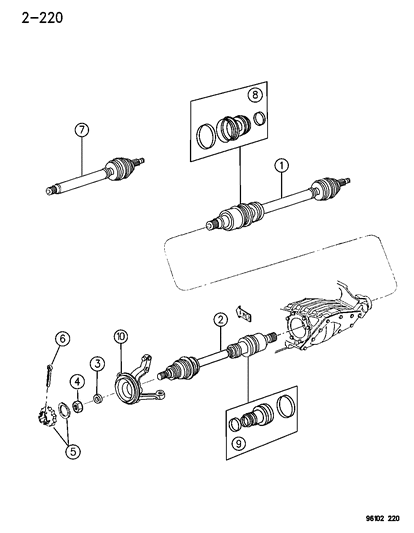
The drive is taken from the transaxle to the wheels through two drive axles where the inner end of each drive axle is splined on the differential side gears. The axle shaft oil seals that are situated in the transaxle can be renewed only if the axle shafts are removed. Axle shafts are splined on their outer ends to the front wheel hubs and fastened with a large nut. Each axle shaft assembly is made of an inside and outside CV joint joined through an axle half, the inside of which every model comprises a tripod kind CV joint which permits both angular and axial movement. If the sealing boot deteriorates, it is possible to disassemble the inner CV joint and rinse it while any problem with the joint's parts means that the entire axle shaft must be installed anew. Outer CV joint is a ball-and-cage design which can travel in all angular but no axial plane, and non-repairable save the hub/bearing shield and sealing boot of specific models. The boots should be inspected periodically for signs of wear and deterioration; and if the CV joint boots are damaged and leaking lubricant, the damaged boot should be replaced immediately to avoid causing harm on the CV joints due to lack of lubrication and or water damage. Some of the boots need to be removed to enable replacement of the axle shaft, though there are some in auto parts stores that are split boots that can be replaced from the front without disassembling the car. It is necessary, though, to pull the axle shaft away with the CV joint and wash it to filter out abrasive elements that hasten wear. Signs of worn or damaged CV joints are such things as wet spots on the inside of the joint, clunking sound when turning corners, discomfort after the car has been driven slowly for some distance then accelerating, and vibrations at high cruising speeds. For worn splines, or sloppy CV joints deeply grasp each axle at the time holding CV joint housings and rotate each axle in both directions for end play, as well as look for cracks, dents, and distortion in the axle shafts.