
My Garage
My Account
Cart
Genuine 1995 Jeep Wrangler Harmonic Balancer
Engine Harmonic Balancer- Select Vehicle by Model
- Select Vehicle by VIN
Select Vehicle by Model
orMake
Model
Year
Select Vehicle by VIN
For the most accurate results, select vehicle by your VIN (Vehicle Identification Number).
1 Harmonic Balancer found

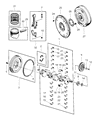 Product Specifications
- Other Name: DAMPER/Pulley; Crankshaft Damper, Damper, Vibration Damper
- Item Weight: 8.50 Pounds
- Item Dimensions: 8.4 x 8.1 x 3.9 inches
- Condition: New
- SKU: 33002920
- Warranty: This genuine part is guaranteed by Mopar's factory warranty.
1995 Jeep Wrangler Harmonic Balancer
On our website, we proudly offer genuine 1995 Jeep Wrangler Harmonic Balancer at the market's great competitive prices. We are confident that choosing brand new OEM 1995 Jeep Wrangler Harmonic Balancer from our site will save you both trouble and money.
1995 Jeep Wrangler Harmonic Balancer Parts Questions & Experts Answers
- Q:How to replace or install a Harmonic Balancer in a 2.5L four-cylinder engine on 1995 Jeep Wrangler?Posted by Montee S.A:Disconnect the cable from the negative terminal of the battery. Remove the drivebelts, tagging each belt as it's removed to simplify reinstallation. If the vehicle has a fan shroud, unscrew the mounting bolts and position the shroud out of the way. Raise the vehicle and support it securely on jackstands. For vehicles with a manual transmission, apply the parking brake and put the transmission in gear to prevent the crankshaft from turning, then remove the crankshaft pulley bolts. For those with an automatic transmission, it may be necessary to remove the starter motor and immobilize the starter ring gear with a large screwdriver while an assistant loosens the pulley bolts. On vehicles with serpentine belts, the pulley and harmonic balancer are combined as one piece, so there are no pulley bolts to remove. To loosen the harmonic balancer retaining bolt, install a bolt in one of the pulley bolt holes, attach a breaker bar, extension, and socket to the harmonic balancer retaining bolt, and immobilize the crankshaft by wedging a large screwdriver between the bolt and the socket before removing the retaining bolt. Remove the harmonic balancer, using a puller if necessary. Apply a thin layer of multi-purpose grease to the seal contact surface of the harmonic balancer. Slide the harmonic balancer onto the crankshaft, ensuring the slot in the hub is aligned with the Woodruff key in the end of the crankshaft. Once aligned, tap the balancer onto the crankshaft with a soft-face hammer, using the retaining bolt to press the balancer into position. Tighten the harmonic balancer-to-crankshaft bolt to the specified torque. Install the crankshaft pulley if equipped on the hub and tighten the bolts to the specified torque, using Locktite on the bolt threads. Finally, install the drivebelts and replace the fan shroud if equipped.Answered by Mopar Parts Specialist Cristian / May 26, 2023
