
My Garage
My Account
Cart
Genuine 1993 Dodge Ramcharger Cylinder Head
Head- Select Vehicle by Model
- Select Vehicle by VIN
Select Vehicle by Model
orMake
Model
Year
Select Vehicle by VIN
For the most accurate results, select vehicle by your VIN (Vehicle Identification Number).
2 Cylinder Heads found
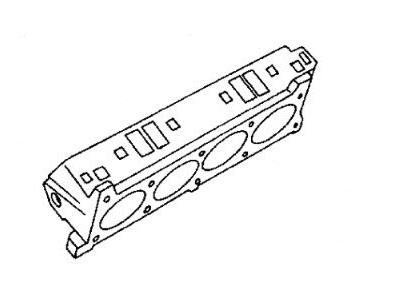
1993 Dodge Ramcharger Head Cylinder
Part Number: R5852480$1125.15 MSRP: $1365.00You Save: $239.85 (18%)Product Specifications- Replaced by: R5852480AB
- Item Weight: 54.10 Pounds
- Item Dimensions: 28.6 x 13.0 x 9.8 inches
- Condition: New
- Fitment Type: Direct Replacement
- SKU: R5852480
- Warranty: This genuine part is guaranteed by Mopar's factory warranty.

 Product Specifications
- Other Name: Head, Cylinder; Cylinder Head
- Replaces: 5014749AA, 5014749AB
- Item Weight: 149.90 Pounds
- Item Dimensions: 35.4 x 13.5 x 8.8 inches
- Condition: New
- Fitment Type: Direct Replacement
- SKU: R5014749AB
- Warranty: This genuine part is guaranteed by Mopar's factory warranty.
1993 Dodge Ramcharger Cylinder Head
On our website, we proudly offer genuine 1993 Dodge Ramcharger Cylinder Head at the market's great competitive prices. We are confident that choosing brand new OEM 1993 Dodge Ramcharger Cylinder Head from our site will save you both trouble and money.
1993 Dodge Ramcharger Cylinder Head Parts Questions & Experts Answers
- Q:What steps should be taken for thorough cleaning and inspection of the cylinder head and valve train components during an engine overhaul on 1993 Dodge Ramcharger?Posted by Abuhamra A.A:Washing of the cylinder head and associated valve train parts and then examining them will allow you to appreciate how much valve servicing will be required as you overhaul the engine. first remove all the old gasket material and sealing compound from the head gasket, intake manifold and exhaust manifold sealing surfaces and also clean around the coolant passage ways for any scales. In the oil holes use a stiff wire brush and in every thread use the correct sized tap to remove corrosion and thread sealant as well as debris if compressed air is available. Erase the carbon from the exhaust's threads and the intake manifold stud threads by using a die; for the rocker arm shaft bolt threads use a wire brush. This is followed by solvent washing of the cylinder head accompanied by rigorous drying and the use of chemicals for decarbonizing the cylinder head should be done carefully. Rocker arms, shafts and pushrods are cleaned with solvent, and after that they were dried as well as valve springs, keepers, retainers, rotators and spring seats in which all these processes are performed one valve at a time to avoid mixing of the parts. Removal of thick scale from valves should be made using a scraper and the use of a motorized wire brush should be done on the heads and stems of the valves while arranged in an orderly manner. Look for cracks and indications of leakage on the head; use a straightedge and feeler gauges to measure warpage in the head gasket mating surface. Check the condition of the valve seats, check and measure the inside diameter of the valve guides the measurements made would be used to compute the valve stem to guide clearance. The rocker arm faces should also be checked for wear and there should be no scuffing at the ends of the pushrods, in addition, the pushrods should also be rolled on a flat surface for bending. A valve face may develop cracks and pits; measure the width of the valve margin to ensure that the valve face is not worn out and check the stem diameter so that a new valve can be ordered in case that one needs replacement. Check each valve spring for wear and measure its free length to meet the specification; check also the spring retainers and keepers for wear and crack. If during the inspection the condition of the valve components is not satisfying then reassemble the valves in the cylinder head and follow further recommendations for valve servicing; if during the inspection there is no a lot of worn elements then valve train components can be reinstalled without deep roughing.Answered by Mopar Parts Specialist Cristian / Nov 16, 2022
Related 1993 Dodge Ramcharger Parts
 1993 Dodge Ramcharger Rocker Arm
 1993 Dodge Ramcharger Cylinder Head Gasket
 1993 Dodge Ramcharger Rocker Arm Pivot
 1993 Dodge Ramcharger Timing Cover