My Garage
My Account
Cart
Genuine Chrysler Cirrus Cylinder Head
Head- Select Vehicle by Model
- Select Vehicle by VIN
Select Vehicle by Model
orMake
Model
Year
Select Vehicle by VIN
For the most accurate results, select vehicle by your VIN (Vehicle Identification Number).
6 Cylinder Heads found
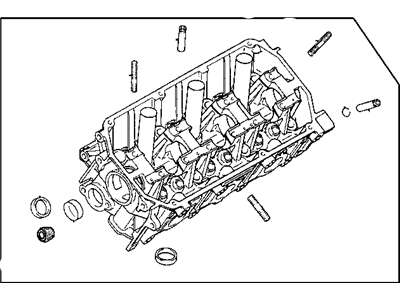
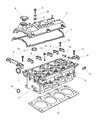

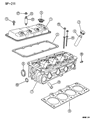
Chrysler Cirrus Cylinder Head
The Chrysler Cirrus Cylinder Head is responsible for directing the air fuel mixture into the combustion chambers of the engine while allowing the exhaust to exit smoothly and efficiently. This enables the engine of the vehicle to breathe easily and remain airtight under pressure. The early cast-iron versions on Chrysler products were durable but heavy. The later aluminum Cylinder Head castings were lighter, which gave better weight distribution, dissipated heat more quickly, and permitted a slightly higher compression without knock. Each Cylinder Head in every Chrysler Cirrus uses torque-to-yield head bolts that stretch to an exact limit, spreading clamping forces evenly. The uniformity of torque allows the head gasket to effectively resist leaks between cylinders, coolant passages, and oil galleries. When sealed properly, the assembly prevents misfires, overheating, and mixing oil and coolant, which rob power and prevent any Cirrus from incurring expensive damage. Free-flowing inner port configurations cut down on restrictions so air can rise up and horsepower can climb, but worn guides, valves, seats, and warped surfaces can ruin the effectiveness of even the very premier port job. Through the production years, Chrysler modified the port contouring and strengthened stressed areas, resulting in a Cylinder Head that makes every Cirrus owner's life a little stronger and more reliable for smooth daily driving. The Cylinder Head is crucial for optimal engine performance.
Looking for affordable and high-quality auto parts? Then you have already arrived at the proper online shop. We offer all Chrysler Cirrus Cylinder Head at great affordable prices. Moreover, all genuine Chrysler Cirrus Cylinder Head come with a manufacturer's warranty. In the long run, you would realize you have saved a lot of trouble and money with OEM parts from here.
Chrysler Cirrus Cylinder Head Parts Questions & Experts Answers
- Q:What precautions should be taken before beginning the cylinder head removal procedure in V6 engine on Chrysler Cirrus?A:Allow the engine to cool completely before beginning this procedure. Disconnect the negative battery cable from the ground stud on the left shock tower. Position the number one piston at Top Dead Center. Remove the upper and lower intake manifolds, drain the cooling system, and remove the spark plugs and spark plug wires, leaving the plug wires attached to the distributor cap. If removing the right (rear) cylinder head, remove the distributor. Remove the thermostat housing from the rear of the cylinder heads and the rocker arm shaft assemblies. If removing the right (rear) cylinder head, remove the bolts securing the power steering reservoir and hoses to the cylinder head and position them out of the way. Disconnect the power steering pump bracket from the engine and remove the exhaust manifold(s). If removing the left (front) cylinder head, remove the EGR solenoid/transducer assembly and EGR valve from the rear of the cylinder head. Remove the timing belt and camshaft sprocket(s). Clearly label and disconnect any hoses, lines, brackets, or electrical connections that may interfere with cylinder head removal. Loosen the cylinder head bolts, 1/4-turn at a time, in the reverse order of the tightening sequence until they can be removed by hand. Carefully lift the cylinder head straight up and place it on wood blocks to prevent damage to the sealing surfaces. If the head sticks to the engine block, dislodge it by placing a wood block against the head casting and tapping the wood with a hammer or by prying the head with a prybar placed carefully on a casting protrusion. Remove all traces of old gasket material from the block and head, using special gasket removal solvents available at auto parts stores. Be very careful not to gouge the sealing surfaces of the aluminum cylinder head. When working on the block, place clean shop rags into the cylinders to help keep out debris and use a vacuum to remove any contamination from the engine. Use a tap of the correct size to chase the threads in the engine block and clean and inspect all threaded fasteners for damage. Inspect the cylinder head bolt threads for "necking," where the diameter of threads narrow due to bolt stretching; if any cylinder head bolt exhibits damage or necking, it must be replaced. Using a precision straightedge and feeler gauge, check all gasket surfaces for warpage; if the warpage on any surface exceeds the limits, the discrepant component must be replaced or resurfaced by an automotive machine shop. Install the camshaft(s) if removed and place a new gasket on the engine block, ensuring all passages in the block align with the holes in the gasket. Use no sealer unless indicated by the gasket manufacturer and note any directions printed on the gasket such as "Front" or "This side up." Place the cylinder head(s) in position on the engine block, install the washers onto the cylinder head bolts, apply clean engine oil to the cylinder head bolt threads, and install them into the cylinder head. Tighten the cylinder head bolts in the sequence shown, progressing in three stages to the torque. The remaining installation steps are the reverse of removal. Refill the cooling system and check all fluid levels as necessary. Start the engine and let it run until normal operating temperature is reached, checking for leaks and proper operation.