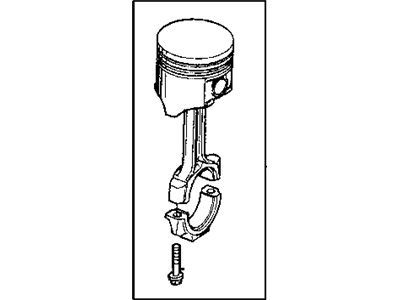
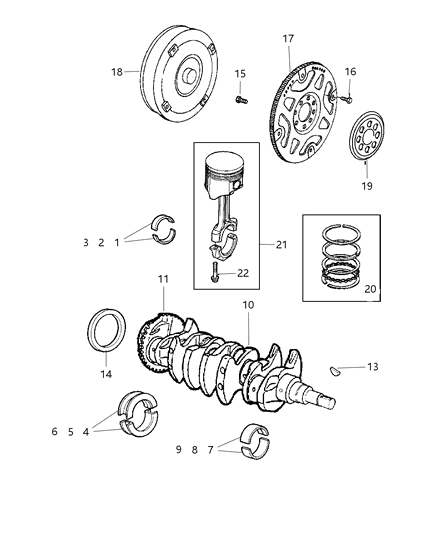
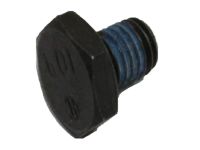
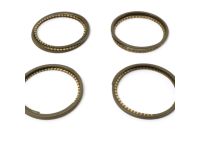
Before teardown of the piston as well as the connecting rod; the cylinder head(s), oil pan, and oil pump have to be removed. In the case of 2.4L four-cylinder engines, the balance shaft carrier assembly must also be disassembled. It is recommended to use a fingernail to feel for any ridge at the upper limit of ring travel and if identified it must be pulled out by the use of ridge reamer before the piston/connecting rod assemblies are pulled out to avoid piston breakage. Once the bubbles or ridges have been sluiced off turn the engine over so that the heads are in the air and the crank is down. It is advised to use feeler gauges to check the connecting rod end play before proceeding to remove any of the main bearing cap assemblies or the connecting rods which have to be done for each connecting rod. Label the location of the connecting rods and caps with a permanent marker so that one can easily replace them in their correct position especially in 3.7L V6 engines. Unfasten the connecting rod cap screws slowly, and then remove the cap and bearing insert and finally do as the following is described, push the connecting reading/piston through the apex of the engine out. Do this for the other cylinders, toss the old rod cap bolts in the trash, and put new ones when assembling the engine. As a rule it is the caps and inserts must be screwed at least with the fingers in order to prevent contact of bearing surfaces. The pistons and connecting rods are then in a position to be inspected and turned round if required. While replacing the piston rings, one should verify the ring end gaps and piston ring side clearances should be also checked. Disposing of the piston/connecting rod assemblies, and the new rings on the board, to match them during assembly. Place the top ring in the first cylinder, align it with the cylinder walls and use the feeler gauges to measure the end gap. If the gap is wrong, then fine-sand the ring ends until you get the correct size of the gap. Do this for each ring and make sure that each of the components are well matched with the other. After the end gaps have been confirmed, place the rings in the pistons , the oil control ring, then middle and top rings identifying marks facing the right way. Before the installation of this cylinder, make sure the interior of the cylinder walls is polished, also the edges must be refined and must contain crankshaft. The bearing surfaces should be degreed and new cap bolts must be fitted. The crankshaft end play should next be checked with a connecting rod bearing oil clearance with Plastigage, the surfaces having first to be wiped clean and free of oil. A clearance different from the one called for should prompt the examination of the bearing sizes and journal diameter. After making sure that all parts are fit in position, spread fresh coat of grease on the bearing faces, replace the connecting rod to its position and fasten the rod cap with new bolts and tightened to the recommended torque. Perform this for all piston / connecting rod assemblies every time, make sure that they are clean and correctly positioned. Last, turn the crankshaft around to examine, if there is binding and to again measure the connecting rod end play to adjust as required.