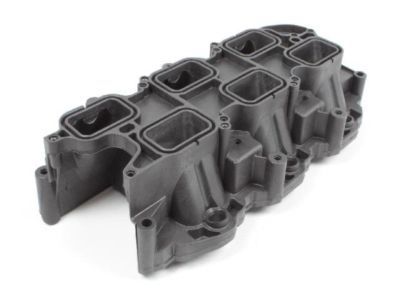
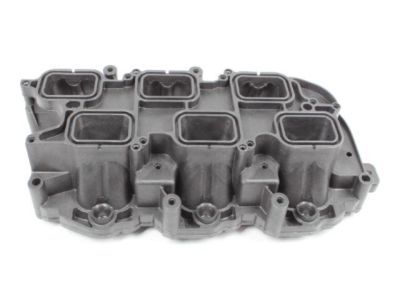
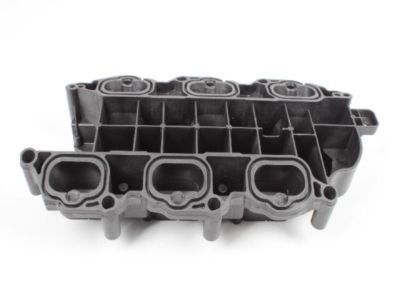
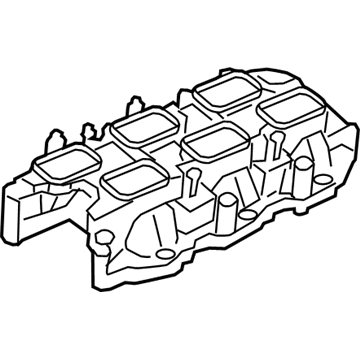
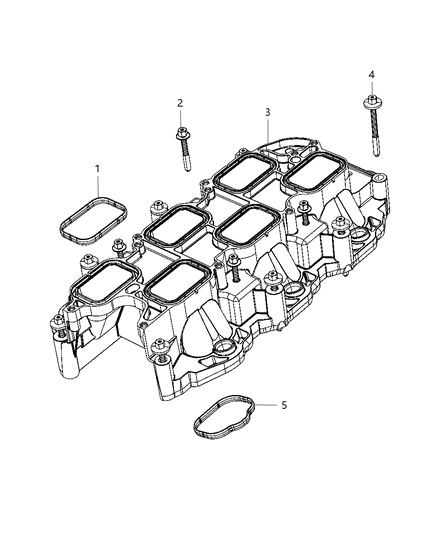
Disconnect the negative cable from the battery, remove the air filter housing and the accelerator cable, and for models with automatic transmission, disconnect the transmission line pressure cable. Detach the cruise control cable if equipped, then disconnect the vacuum connector on the intake manifold by lifting the connector assembly up and out of the bracket and pulling it apart. Label and disconnect all vacuum and electrical connectors on the intake manifold, relieve the fuel pressure, and disconnect the fuel supply and return lines from the fuel rail assembly, capping the open ends. Loosen the serpentine drive belt, remove the power steering pump and bracket from the intake manifold without disconnecting the hoses, and ensure the pump remains upright to prevent fluid spillage. Remove the fuel rail and injectors, then take off the intake manifold heat shield by removing the bolts. Unscrew the intake manifold bolts, noting that four can be accessed from the top while the remaining four require reaching below the manifold. Remove the EGR tube from the intake manifold, pull the manifold slightly away from the engine to disengage it from the locating dowels, and lift it out of the engine compartment. Remove the exhaust manifold, as both manifolds share a common gasket, and thoroughly clean the gasket mating surfaces to eliminate all traces of old gasket material. If replacing the manifold, ensure all fittings are transferred to the new one, position a new gasket on the cylinder head using the locating dowels, and install the exhaust manifold, hand-tightening the nuts. Loosely position the intake manifold on the cylinder head, install the EGR tube between the manifolds, and then install the manifold retaining bolts, tightening all fasteners in the specified sequence. Reinstall the remaining parts in reverse order of removal, and before connecting the fuel lines to the fuel rail, replace the O-rings in the quick-connect fuel line couplings. Finally, run the engine and check for leaks.